
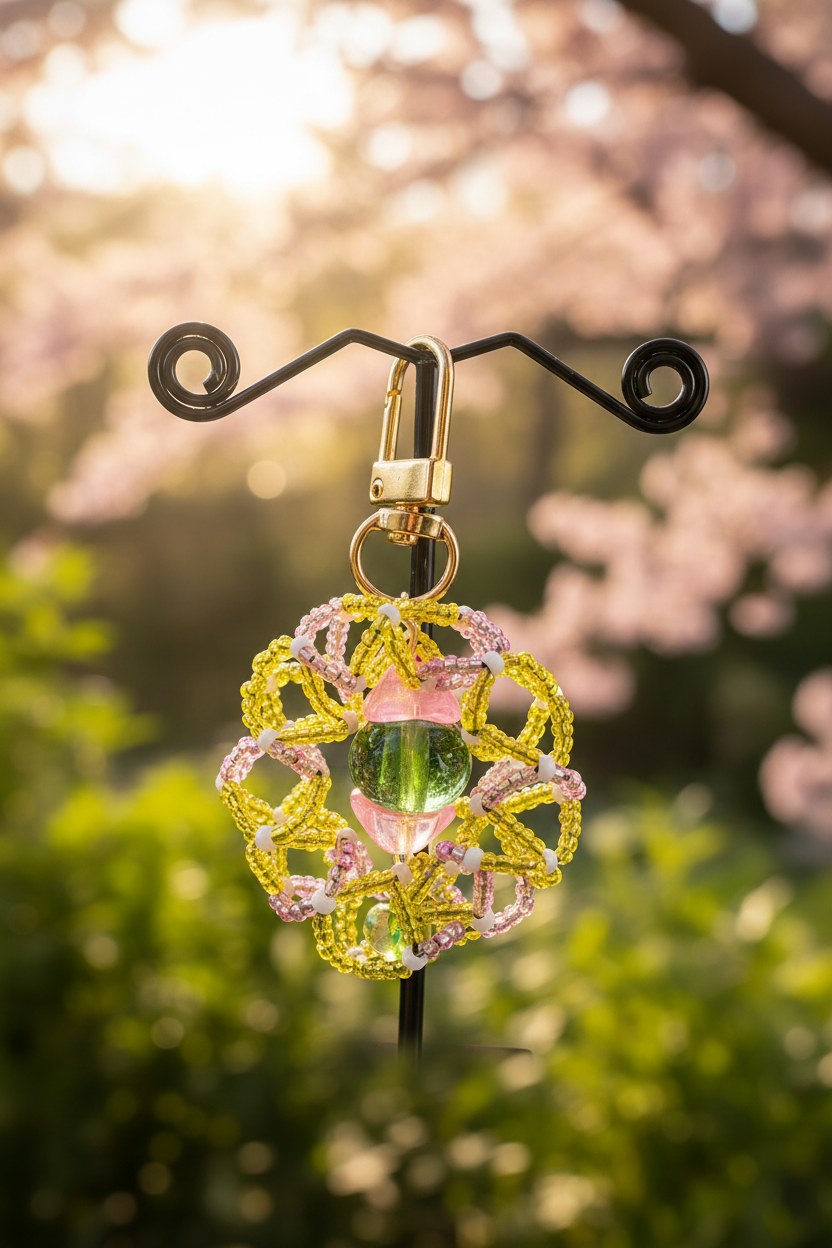
A finished piece can make its arrival look inevitable. The color sits where it belongs. A curve seems to have always been waiting for the bead, the shard, or the piece of metal beside it. But the worktable knows better. Before a form becomes clear, there is usually a period of looking without an answer.
That period is not empty. It is where a piece begins to make demands. A material asks to be turned another way. A focal element refuses the first setting. A color that looked brilliant in the hand becomes too loud beside its neighbor. The work changes through these small refusals. In the studio, the aim is not to force every object into the first idea, but to stay with the question long enough for a more particular form to appear.
The first arrangement is only a question
Most pieces begin with a gathering rather than a plan. Materials are laid out together: glass, beadwork, a reclaimed element, a fragment with an unfamiliar texture, a color that will either open the composition or close it down. At this stage, nothing has earned its final place. The table is full of possibilities, and some of them need to be discarded before the work can breathe.
It is tempting to mistake the first exciting arrangement for the answer. Sometimes it is close. More often, it is simply useful evidence. It shows what feels too symmetrical, too polite, too heavy, or too expected. A piece becomes more honest when it is allowed to move beyond the arrangement that first made sense.
This is where making becomes a form of listening. The materials do not speak in sentences, but they do create pressure. A hard metal curve can make a soft luminous surface feel more vulnerable. Dense beadwork can give a fragment a center of gravity. One small interval of empty space can make a crowded composition finally feel alive. These are decisions the eye understands before language catches up.

Let the material keep some of its past
Found and reclaimed materials bring a past into the room. Their marks, edges, and familiar shapes are not neutral. They already have a history of use, industry, ornament, or accident. That history is part of their charge. The task is not to erase it until the source becomes invisible. The task is to put it into a new relationship with everything around it.
An aluminum tab can remain recognizably industrial while becoming a radiating frame. A glass focal can retain its softness while gaining tension from an edge of metal. The contrast is often more interesting than a seamless finish. One material remembers the ordinary world. Another creates a small departure from it. Between them, a piece begins to suggest a place that did not exist before.
That is why a one-of-one work cannot be reduced to a recipe. The same category of material may appear again, but it will not arrive in exactly the same condition. It will catch light differently, carry a different nick or curve, meet a different color at a different moment. The response has to stay open. Repetition can create a language, but it should not turn the work into an imitation of itself.
Revision is where the form becomes specific
Revision is not always a grand correction. Sometimes it is a matter of moving one element a few millimeters, changing the sequence of beads, or removing the detail that was trying too hard to explain the whole piece. These adjustments can be nearly invisible in the finished work, yet they decide whether it holds together.
There is a difference between more and enough. A studio table can encourage accumulation because every material seems to offer another possibility. But a piece needs places to rest. It needs an area of quiet that makes the charged parts legible. Removing something is often less dramatic than adding it, but it can reveal the structure that was there all along.
The same is true of symbolism. A work may carry echoes of a talisman, a flower, a star, a relic, or an artifact without becoming an illustration of any one thing. The symbol becomes stronger when it is felt rather than announced. It can remain a private association for the collector, or change meaning as the work moves through different days and places.

The pause is part of the process
Not every decision should be made while the materials are still warm from handling. A piece sometimes needs to be left alone. Returning the next morning changes the scale of attention. What felt bold can look crowded. What seemed uncertain can become the most necessary element. The pause allows the work to stop borrowing momentum from the act of making.
Looking from a distance matters, too. A detail that is beautiful up close may disappear when the work is worn or displayed. A silhouette has to carry its own energy from across a room, while closer looking should offer another layer. The aim is not perfection from every possible angle. It is a form with enough internal life that each angle gives something back.
This slow return keeps the work from becoming a demonstration of technique. Skill is present in the construction, but technique is not the final subject. The finished piece should feel as though its materials have found a way of being together that could not have been reached by hurry alone.
The hand and the eye need different things
Making asks for two kinds of attention. The hand notices weight, resistance, sharpness, and the small practical limits of construction. It learns what can be joined, supported, worn, or moved without asking the material to become something it is not. The eye notices rhythm, interruption, shadow, and the way a surface changes from one angle to the next. A decision that works perfectly in the hand can still look inert. A form that looks effortless from across the room may need a more careful structure before it can exist in the world.
That conversation is one of the reasons the work takes time. The eye may ask for a lighter line while the hand asks for a stronger connection. The hand may insist on a practical change that gives the eye an unexpected new shape. Neither side is a compromise in the disappointing sense. They are part of the same act of discovery. A piece becomes more convincing when its visible character and its physical construction arrive at the same conclusion.
Wearable work makes that especially clear. A necklace is not only seen against a plain surface. It has to move with a body, sit near skin and fabric, and keep its presence without becoming a burden. An earring has to hold its balance as it catches light. A small object may not be worn, but it still has to invite an encounter from the hand as well as the eye. It needs a shape that feels considered when someone picks it up, turns it over, and sets it down again.
These practical questions do not diminish the mystery of a piece. They give the mystery somewhere to live. The most expressive form still benefits from an honest structure. A collector may not need to know every hidden connection, but the care inside the construction changes the way the finished work can be trusted, handled, and kept close.
Color has to earn its place
Color can be the first thing a collector sees, but it is rarely the first decision the work has made. A bright focal may need a quieter field around it. A dark element can deepen a surrounding color more effectively than another bright accent. Some combinations announce themselves immediately, then become exhausting when they are given too much space. Others appear subdued at first and slowly reveal their temperature as the eye returns.
For that reason, color is tested in relation rather than chosen in isolation. A bead that feels electric by itself may become a useful small interruption beside a warmer surface. A translucent glass element can change character as the background changes. What matters is not whether every color receives equal attention, but whether the work has a place for the eye to enter, travel, and rest.
The same principle applies to texture. Smooth glass, dense beadwork, rougher reclaimed metal, and a polished detail can each hold a different kind of light. Keeping those distinctions present gives the work depth. A uniform surface can be beautiful, but a mixed surface can carry more of the tension that makes a collector want to look closer. The goal is not decoration for its own sake. It is a visual atmosphere with enough contrast to remain awake.
When a piece begins to answer back
There is a point when a work begins to resist unnecessary change. The composition has an atmosphere. Its balance is not mathematical, but it feels held. At that point, adding another detail can break the spell. The work does not become finished because every possibility has been used. It becomes finished because its own character has become clear enough to protect.
That recognition is quieter than certainty. It is a sense that the materials are no longer competing for attention. The glass, beadwork, metal, color, and empty space have started to carry one another. The work can still contain mystery, even contradiction, but the contradiction feels intentional. It has a center.
A collector may never see the rejected arrangements or the details that were removed. They do not need to. What remains is the result of those encounters, held inside the finished object as a kind of pressure. A singular piece carries not only what is visible, but also the paths it did not take.

A work changes again when it leaves the studio
The studio is only the first environment a piece belongs to. Once it is worn, placed on a shelf, given as a gift, or seen in a different light, it enters another chapter. The collector supplies movement, context, and memory. A necklace changes when it meets the posture of a particular person. A small relic changes when it becomes the object someone notices each morning on a desk or windowsill.
This is one reason the work remains one of one. The exact arrangement that emerged in the studio belongs to that individual object, and then it belongs to the individual life that receives it. Another piece may grow from a related question, but it will not repeat the same answer. The studio can return to a material or a symbol without pretending to recreate a moment that has already passed.
Keep room for the unexpected
CrushelloCreations is built through that ongoing conversation with material. The Origins collection follows reclaimed elements, glass, beadwork, and color into wearable forms. TrinketRelics holds small objects that invite a closer encounter. Each is made slowly enough for its own shape, character, and atmosphere to emerge.
For collectors and the curious, the point is not to solve a piece at first glance. It is to meet the work that keeps opening after the first look. The current collection is there to explore when one of those forms begins to feel like it is already asking for a place in your life.
Questions from collectors
Inside the making.
How does a one-of-one piece take shape?
A one-of-one piece develops through material choices, trial arrangements, revision, and time away from the worktable. The final form reflects the particular materials available and the decisions that helped them find a balanced relationship.
Why do handmade works look different from one another?
Handmade works respond to variations in material, color, scale, and construction. Even when a maker returns to a familiar idea, the individual elements and the choices they require create a different result.
Why use reclaimed elements in studio work?
Reclaimed elements bring their own history, texture, and geometry into a new composition. They can create contrast with glass, beadwork, and metal while remaining visible as part of the work’s story.
Are CrushelloCreations pieces repeated exactly?
No. Each physical CrushelloCreations piece is made as a singular work. A future piece may share a material or mood, but the exact arrangement, construction, and character are not reproduced.
Continue reading
Related posts

Behind the Piece
The Guardian of Origins: A New Presence in the Studio
Why a new guardian has entered the CrushelloCreations world, and what it holds open for collectors and the curious.
Read the note
Material Stories
Reclaimed Jewelry and the Problem With Fast Jewelry
A studio reflection on material memory, one-of-one work, and why a piece made slowly can stay with you longer.
Read the note
Collection Stories
Founding Collector Month: The Opening Chapter
A note from the studio on beginnings, one-of-one work, and the next chapter of CrushelloCreations.
Read the note